You have signed the lease, approved the logo and chosen a sign that finally makes the building look like your business. The installer is ready to measure the frontage. Then someone asks a question that should probably have been raised weeks ago:
“Does Brisbane City Council need to approve this?”
This question often comes too late. The sign may already be quoted, the deposit may have been paid and the opening date may be getting close. Nobody wants to discover at that point that the sign needs to be smaller, moved to another part of the building or redesigned entirely.
The answer is not a simple yes or no.
Some Brisbane business signs can be installed without making a formal application. Others require Council assessment, and a few types of advertising devices are prohibited. The outcome depends on the sign itself and the property where it will be displayed—not just the wording or how much the sign costs.
A modest window graphic may be acceptable at one retail tenancy but need approval at a heritage-listed shopfront. An A-frame may work outside one café but fail outside the café next door because the footpath is narrower. The same illuminated sign may also be treated differently depending on nearby homes and the road it faces.
So the better question is:
Does this particular sign comply at this particular Brisbane property?
That is what needs to be established before production begins.
The Quick Answer
Brisbane City Council does not require an application for a sign that qualifies as a permitted or self-assessable advertising device and meets every relevant requirement.
The sign must be an eligible type, be allowed within the property’s applicable City environment, satisfy the relevant measurements and general conditions, and not be installed on a heritage place or in relation to a large development. Illuminated and electronic signs also have to meet additional technical standards. When a sign falls outside those rules, a full assessment may be required.
This is where many business owners become confused. They hear that a particular style of sign is “self-assessable” and assume that every version of that sign is exempt.
It is not the name alone that creates the exemption.
An under-awning sign can be self-assessable, but not if it hangs too low or extends too far. A window sign can be self-assessable, but not if it covers too much glass. A portable footway sign can be permitted, but not if it leaves customers, wheelchair users or parents with prams squeezing around it.
The small details decide the answer.
Why Brisbane Does Not Have One Rule for Every Business Sign
A sign is not assessed only as a piece of marketing. Council also has to consider what is around it.
Will it affect the appearance of the street? Could it distract a driver approaching an intersection? Does it project above a public footpath? Is it attached to an older building with heritage value? Will its light spill into nearby apartments at night?
This is why Council first asks businesses to identify the property zone, determine the relevant environment classification and correctly classify the proposed advertising device. The type of assessment required is then influenced by both the sign and its location.
Council divides assessable signs into two broad pathways.
A standard assessment applies where the type of sign is generally considered an acceptable outcome, provided it meets the normal criteria and conditions.
A generally inappropriate assessment applies where the proposal sits outside the usual expectations. In that situation, the application needs to show that special circumstances justify the sign. It also attracts an additional assessment fee.
That wording matters. “Generally inappropriate” does not necessarily mean impossible, but it does mean a business should not assume approval will follow just because it is prepared to lodge an application.
Sometimes the sensible decision is to change the sign before applying.
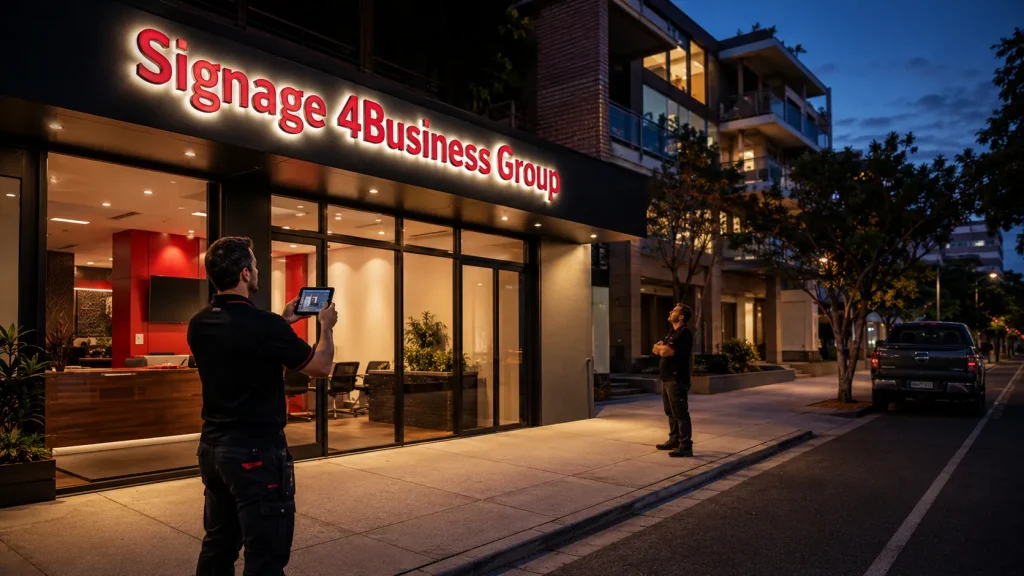
Start With the Property, Not the Artwork
Business owners naturally start with appearance:
- How large should the logo be?
- Which colour will stand out?
- Should the letters be illuminated?
- Can drivers see the sign from the road?
Council starts somewhere else.
It starts with the address.
The property zone, overlays, neighbourhood plan and City environment can all influence what type of signage is allowed. Council advises applicants to use City Plan online to check the zoning before confirming the sign type and assessment pathway.
This can create very different outcomes across Brisbane.
A straightforward commercial tenancy in a normal business area may have several self-assessable options. The same design proposed for a Commercial Character building, a heritage place or a special mall location can need closer assessment.
Council says small businesses in business areas can typically display self-assessable signage when they are outside the Queen Street and Valley malls and the property is not affected by a Heritage or Commercial Character overlay.
That is why it is risky to copy a sign from another business and say, “They installed one, so we can too.”
Their property may not have the same controls as yours.
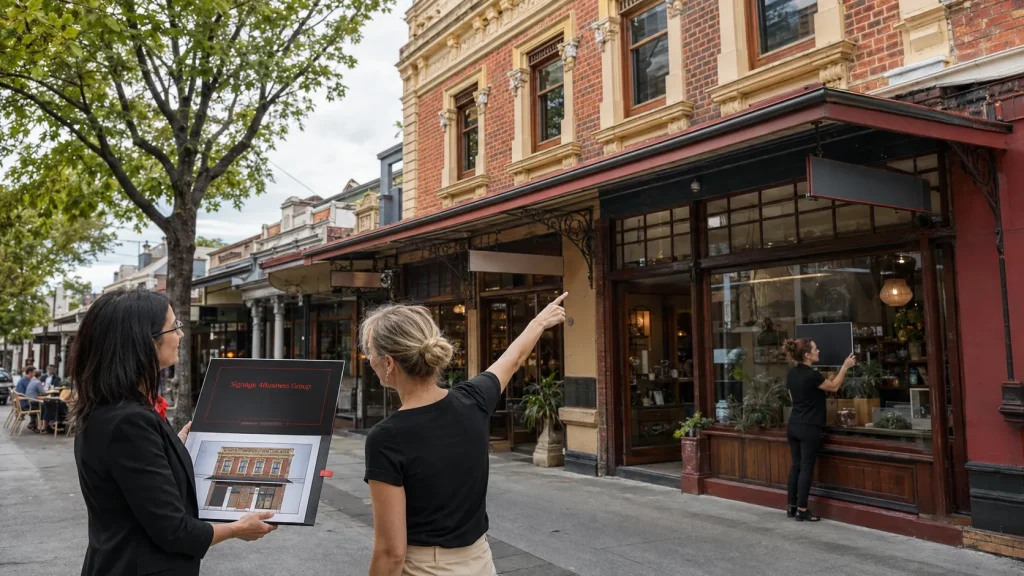
Common Signs That May Be Installed Without a Full Application
Several familiar forms of business signage can qualify as self-assessable. These are not blanket exemptions, but they give a useful starting point.
Awning fascia signs
An awning fascia sign is the branding attached or painted onto the front face of an awning or verandah.
To qualify as a permitted sign, it must stay within the fascia outline and cannot exceed 600 millimetres in height.
This usually works well for traditional shopfronts because the sign uses a part of the building that was already intended to carry identification.
Problems arise when the design creeps above the fascia, includes an oversized backing panel or becomes a separate structure rather than branding contained within the existing awning line.
At that point, it may no longer be an awning fascia sign in the practical sense Council intended.
Under-awning signs
Under-awning signs are useful on pedestrian shopping streets because people walking along the footpath can see them before reaching the entrance.
The self-assessable limits are reasonably specific. The sign must generally sit at right angles to the frontage, be no more than 2.5 metres long, 0.5 metres high and 0.3 metres deep, and have at least 2.4 metres of clearance above the footway. It must not extend beyond the outside edge of the awning, and spacing rules apply between it, other under-awning signs and tenancy boundaries.
This is a good example of why a sign cannot be approved from an artwork file alone.
The design may look compliant on screen, but the final answer depends on the width of the awning, the hanging height, the neighbouring signs and the exact point where it will be fixed.
Window signs and graphics
Window vinyl is often treated as the easy option because no large structure is being attached to the building.
It can still cross the self-assessable limit.
A permitted window sign must not cover more than 25% of the relevant glass panel or panels and must not be larger than two square metres.
Imagine a beauty salon with four front windows. A logo on one pane may be fine. Add opening hours, a service list, photographs, a promotional message and privacy frosting across the remaining glass, and the overall treatment may need another look.
Breaking one large design into several smaller stickers does not necessarily solve the problem. Council is interested in the total display, not how many vinyl files were sent to the printer.
A-frames and footway signs
A-frame signs look simple, but their placement is often more important than their artwork.
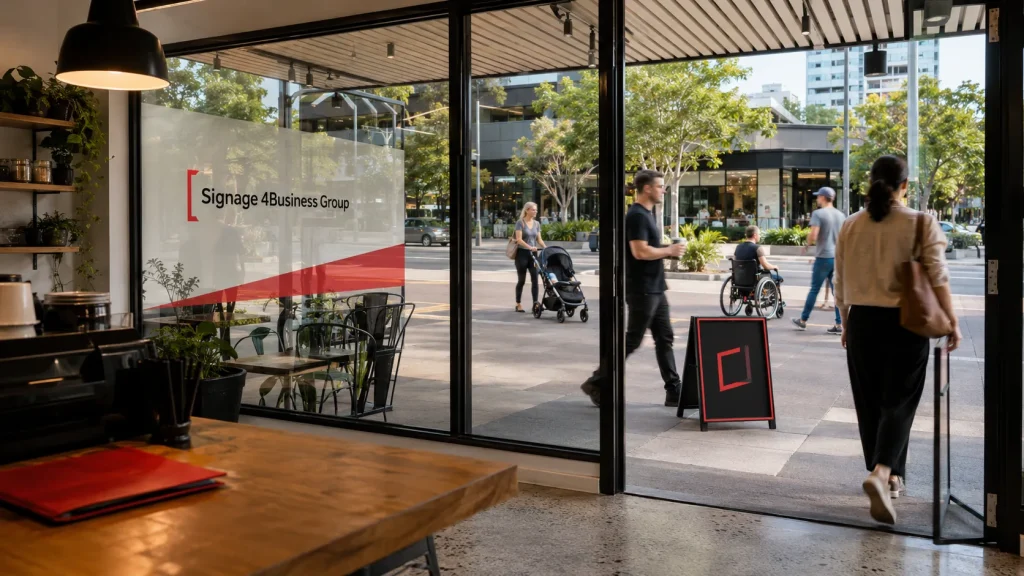
A permitted footway sign can be no more than one metre high, 0.6 metres wide and 0.6 metres deep. It generally needs to sit on the kerb side of the footpath, at least 450 millimetres from the kerb, while leaving a clear pedestrian corridor of at least two metres between the sign and the property boundary. It must remain within four metres of the responsible premises.
It also cannot obstruct street furniture, landscaping or public artwork. Moving, spinning and animated parts are not permitted, and the sign can only be displayed during the business’s trading hours. Council’s general designation allows no more than two qualifying footway signs per shop.
A café owner may look outside and see plenty of empty pavement. That does not mean all of it is available for a sandwich board. The unobstructed pedestrian route has to remain usable in real life, not just appear wide enough in a photograph.
There are also special-location rules. Businesses in Brunswick Street Mall and Chinatown Mall need a Valley Malls A-frame permit. That process includes its own documents, fees and insurance requirement.
Temporary business promotion signs
A temporary sign for a sale, opening or business promotion may also be self-assessable, but “temporary” does not mean it can stay up indefinitely.
The permitted area is no more than four square metres. The sign must be displayed at the premises where the advertised activity is taking place, cannot use an electronic display and may remain up for no more than 14 calendar days within any 90-day period. Only one is permitted per street frontage.
A banner that remains attached for six months because the sale keeps being extended is unlikely to retain the character of a short-term promotion.
Home-business signs
A home business can have a small identifying sign, provided the broader planning requirements are also satisfied.
The self-assessable sign cannot exceed 0.6 square metres and must not be illuminated. It can be painted, mounted to a wall or fence, or freestanding.
The restriction makes sense when you consider the setting. A home business operates within a residential environment, where a large or brightly illuminated sign could change the appearance and amenity of the street.
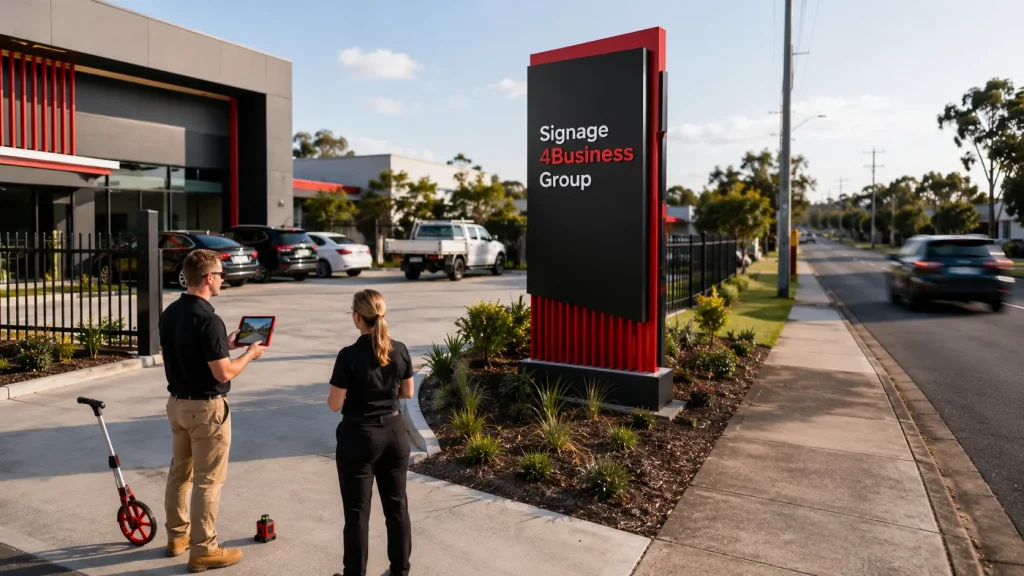
When Approval Becomes More Likely
The need for assessment tends to increase as the sign becomes larger, higher, brighter or more structurally involved.
A major wall sign, projecting blade sign, roof sign, freestanding pylon, large digital display or third-party billboard is not something a business should treat as a routine self-assessable installation.
Consider a warehouse beside a busy road. The owner wants a tall pylon so drivers can recognise the entrance early. From a marketing point of view, the idea is reasonable. From an approval point of view, Council may need to consider the height, advertising area, footing, wind loading, sightlines and effect on drivers.
Now consider a medical practice in a mixed commercial and residential area. The proposed illuminated letters are modest and professionally designed. The question may not be whether the sign looks tasteful. The question may be how bright it is at 11 pm and whether it shines towards nearby homes.
This is why “our sign is not very big” is not always enough.
Illuminated Signs Need More Thought Than Most Businesses Expect
Lighting often gets added late in the design process.
The owner first approves flat lettering, then decides the façade will disappear after sunset. Someone suggests halo illumination or an LED lightbox. It feels like a minor upgrade, but it can change the compliance position.
Council’s technical standards apply to signs with external illumination, internal illumination or electronic display components, including signs that otherwise qualify as permitted devices.
Light must be controlled rather than allowed to spill freely around the façade. Council’s standards require the source to be shielded so light does not extend beyond the advertising device. Where an illuminated or electronic sign is within 100 metres of a residential environment, it must be switched off between 10 pm and 6 am. An appropriate lighting report may also be required as part of an assessment.
For many businesses, this is easy to solve with sensible design, dimming controls and a timer. The important part is deciding that before the sign is manufactured.
A late change can mean replacing transformers, controllers, LED modules or the entire sign cabinet.
Digital Signage Has Its Own Road-Safety Rules
A digital screen gives a business flexibility. A restaurant can change lunch offers. A gym can promote different classes. A real estate office can rotate property listings.
The screen cannot necessarily behave like a television or social media feed.
Where a changeable display is visible from a road with a speed limit of 80 kilometres per hour or less, each message generally needs to remain visible for at least eight seconds. When an electronic display faces a road reserve and is visible to drivers, it must not show video or animated content. Scrolling, moving and “fly-in” transitions are also restricted.
The content should not imitate traffic lights or road-control signs, tell drivers to “Stop” or “Give Way,” or contain material that creates an avoidable distraction. Council also pays closer attention to locations such as intersections, roundabouts, school zones, pedestrian facilities and railway crossings, where drivers already have more information to process.
This means hardware and content need to be planned together.
A sign may be technically capable of playing full-motion video, but that does not mean it can legally operate that way at the proposed location.
Heritage Buildings Are a Different Conversation
Brisbane has many older commercial buildings where the façade forms part of the area’s character.
In those locations, the best sign is often not the biggest one. A sign that works with the original shopfront, awning and architectural lines may be more visible and more credible than a large panel covering half the building.
Council requires an application for an advertising device on a heritage place even when that sign would normally be permitted in the applicable environment. Level 2 fees generally apply. New signage on a site included in the Queensland Heritage Register also needs Queensland Government consideration, and a Heritage Exemption Certificate must be submitted with the Council application. Some upgrades or replacements may fall within a general exemption, but that should be checked rather than assumed.
A tenant may think they are simply replacing an old sign. If the new design introduces different fixing points, covers original building details or adds illumination, the proposal may be more involved than a straight face replacement.
Heritage requirements are much easier to manage when they influence the first concept—not when they arrive after the final artwork has been approved.

Council Approval May Not Be the Only Approval
Another common misunderstanding is that an advertising-device approval covers the entire project.
It does not always do that.
Council signage approval deals with the display of the advertising device under the local law. Depending on the property and installation, the project may also involve planning requirements, building approval, engineering, electrical work and private property consent.
The local law itself does not override other laws regulating land use, development, safety or the environment. Council also advises businesses undertaking building work to seek guidance from a licensed private building certifier or building consultant.
A large pylon may require engineered footings. A projecting sign may need certified brackets and confirmation that the wall can carry the load. A roof-mounted sign may require structural investigation. An illuminated sign needs compliant electrical installation.
This distinction is worth remembering:
Approval for the advertising does not automatically prove that the structure carrying it is safe to build.
Tenants Still Need the Owner’s Permission
Council approval also does not cancel the terms of a commercial lease.
A landlord, body corporate or shopping-centre manager may have separate rules about:
- where signs can be installed
- approved colours and materials
- illuminated lettering
- penetrations into the façade
- nominated installation contractors
- working hours
- insurance
- removal at the end of the lease.
Where the applicant is not the landowner, Council requires a completed landowner-consent form with the signage application.
This is especially important for tenants in centres with a signage manual. A proposal can comply with Council’s rules and still be rejected by centre management because it does not match the building’s design standards.
Get the private approval and the regulatory position aligned before production.
Can a New Tenant Reuse the Previous Sign?
Sometimes the easiest-looking option creates the most uncertainty.
A new tenant moves into a shop with an existing lightbox above the entrance. The cabinet is already there, so the plan is to replace the old face with the new business name.
That may be straightforward, but three questions should be answered first:
- Was the original sign approved or legitimately self-assessable?
- Is any existing approval still current?
- Is the new work limited to changing the graphic, or does it alter the sign itself?
Council allows an existing approval to be transferred or amended. However, an amendment cannot be used where the change affects the sign’s built form or results in an electronic display component exceeding four square metres. A new application is required in those circumstances.
Changing an acrylic face is one thing. Enlarging the cabinet, moving it, adding an LED screen or replacing the supporting structure is another.
The fact that a sign has been hanging on the building for years is not proof that every future version is automatically covered.
What the Application Process Looks Like
When approval is required, the application is easier to handle when the documents answer obvious questions clearly.
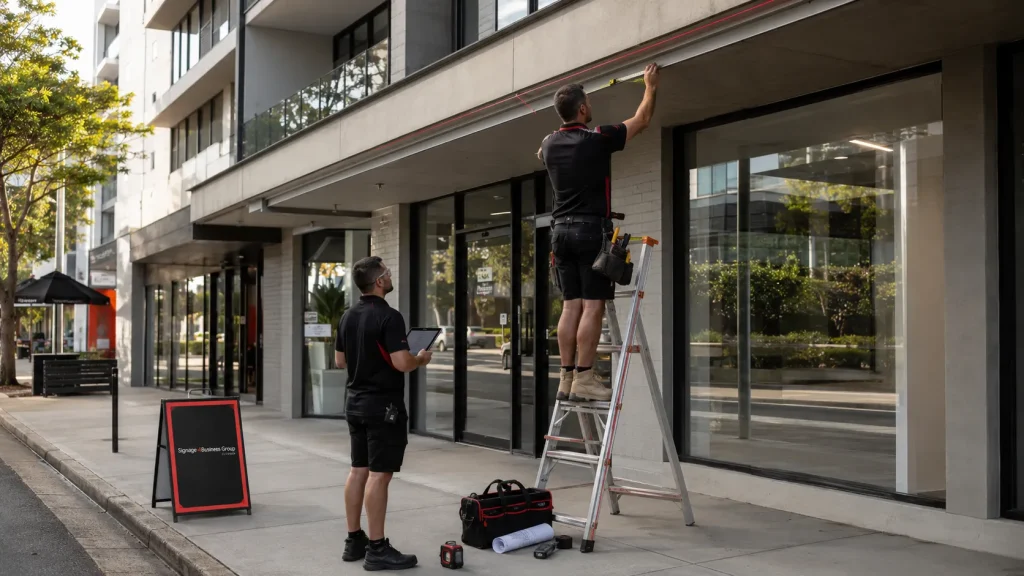
Council asks for accurate site plans showing existing structures and the proposed signage, along with design and construction details such as drawings or photographs showing the size and shape. Additional documents may be required depending on the device. Landowner consent is mandatory where the applicant does not own the property.
A good submission may include:
- a site plan showing exactly where each sign will sit
- a front elevation or clear photograph with the sign marked
- width, height, depth and advertising area
- height above ground or footpath
- materials and colours
- fixing and support details
- illumination specifications
- electronic-screen behaviour
- relevant engineering or heritage documents.
Several signs on one property can be included in one application, although assessment and annual fees may still apply to each device.
Council says applicants undergoing full assessment will receive an initial response within 30 working days. That is an initial response, not a promise that every application will be fully decided within 30 working days. The next steps depend on the complexity of the proposal and whether more information is needed.
A missing dimension, unclear site plan or incomplete lighting proposal can add time that a new business may not have allowed for.
What Does Signage Approval Cost in Brisbane?
Council’s 2026–27 fees are based on the application plus the assessment fee for each sign and the relevant annual approval fee for each device.
The current charges include:
| Charge | Current fee |
| Application fee | A$42.25 |
| Level 1 assessment | A$416.55 per device |
| Level 2 assessment | A$1,054.60 per device |
| Level 3 assessment | A$3,115.70 per device |
| Annual Level 1 approval | A$96.90 per device |
| Annual Level 2 approval | A$192.40 per device |
| Annual Level 3 approval | A$385.05 per device |
| Temporary-device approval | A$29.50 per month or part month |
| Office pre-lodgement advice | A$502.60 |
| On-site pre-lodgement advice | A$845.30 |
Additional fees apply where a proposal is categorised as generally inappropriate.
For one device, the basic first-year Council charges begin at about A$555.70 for Level 1, A$1,289.25 for Level 2 and A$3,543 for Level 3. These figures do not include engineering, building certification, electrical work, heritage advice, redesign or installation costs.
This is why early checking is worthwhile. The expensive mistake is rarely the application fee. It is manufacturing the wrong sign and then paying to change it.
How Long Does the Approval Last?
The approval period will be stated in the decision. Under the local law, an approval generally runs for one year when no different term is specified and may renew when the required annual fee is paid.
Where the approval involves building work, the work must substantially start within six months and be completed within one year. Council can consider one extension of up to six months, but the request must be made before the deadline and meet the application requirements.
Approval is not something to obtain and then forget.
Annual fees, operating conditions, maintenance and any limits on lighting remain relevant after the installer has left.
What Happens When an Unapproved Sign Is Installed?
Council does not need to wait for a major accident before acting.
A sign can come to attention through an inspection, a complaint, a footpath obstruction, excessive lighting or obvious non-compliance.
The local law allows Council to issue compliance notices and take action relating to removal, repair, maintenance and operation. It can also recover certain costs connected with remediation, removal, storage and disposal.
Installing or displaying a sign without approval—where it is not a permitted device—carries a maximum penalty of 50 penalty units. The Queensland penalty-unit value for the 2026–27 financial year is A$172.70, making the maximum equivalent A$8,635.
Most business owners will never face the maximum penalty. The more immediate problem is usually practical: removing a finished sign, repairing the façade, delaying the opening or paying for a second design.
A compliance problem does not only affect the sign budget. It can affect the whole launch.
A Sensible Check Before You Order
Before approving the final quote, put the sign design beside the property information and ask:
- What is Council’s formal name for this sign type?
- What are its complete dimensions?
- Where exactly will it be installed?
- What property zone and City environment apply?
- Are there heritage, Commercial Character or neighbourhood-plan controls?
- Does the design use lighting or changing digital content?
- Is the sign visible from a major road or complex intersection?
- Will it project over a footway?
- Does it require new supports, footings or electrical work?
- Has the landlord or property owner approved the same design?
- Does it qualify as permitted, or does it need assessment?
These questions are far more useful than asking whether “shop signs” generally need approval.
A sign is designed for a specific building. Its compliance should be checked the same way.
Final Thoughts
Many Brisbane businesses can install effective signage without going through a full Council application. The rules are not designed to prevent every café from having an A-frame or every shop from displaying its name.
The difficulty comes from assuming that the general rule applies without checking the details.
A sign can miss the self-assessable pathway because it is slightly too large, hangs too low, covers too much glass, sits on the wrong part of the footpath or is installed on a property with additional controls.
The right time to identify that is before the sign is manufactured.
At Signage 4Business Group, we believe the design, property and installation method should be considered together from the beginning. A sign should not only look right in the artwork. It should make sense on the building, work for the business and avoid preventable approval or installation problems.